Moses Hategeka aus Uganda schreibt, dass nachhaltige Landwirtschaft ein komplexes, globales Puzzle ist. Trotzdem, oder gerade deswegen, sei sie aber der Schlüssel für die weltweite Ernährungssicherheit. Und für die Erreichung der nachhaltigen Entwicklungsziele. Ein Gastbeitrag:
„On my return from a practical agricultural learning tour of various farms in Germany, that was concluded with a participation in the panel discussion on „Solutions for global Agriculture“ held, at the university of Bonn, organized, by its center for Development Research (ZEF), a few months back, I went to Isingiro district, Western Uganda, to get a firsthand accounts of prolonged draught climatic impact from residents. One elderly man, Mr. Patrick Barigye, on behalf of other residents from Kinoni Sub County, had this to say: “The prolonged draught that have befallen our area for months now, have resulted into the drying of crops in the fields and thousands of death of our livestock, our natural water sources like springs, swamps, wetlands and rivers have dried up too, leaving us famine and hunger prone. We are so severely starved and in need of emergency food aid.” I asked what he thinks is the cause of this prolonged draught. He responded: “Thirty years back, the bare hills you are seeing, were used to be covered by trees and thick green vegetation. But human activities such as overgrazing, charcoal burning, wetland-, swamps-, and forests devastation, in search of more land for cultivation and grazing coupled with poor methods of farming fueled by ever increasing population have resulted into massive environmental degradation. Thus, we no longer receive the reliable and adequate rainfall like we were used to thirty years back”
Fertile Soil, an endangered species
For the past three decades, deforestation, skyrocketing population, wetlands and swamps destruction, poor farming methods and uncoordinated industrial development in developing countries; and use of fertilizers and agrochemicals, accompanied with heavy tillage practices in developed countries, have led and are leading to severe global land degradation. In fact, according to the University of Bonn, Center for Development Research, report, titled, ‘’Economics of land degradation and improvement, A global assessment of sustainable development”, about 30% of the global land area, inhabited by 3.2 billion people, has experienced severe land degradation over the past three decades causing an estimated annual cost of about 300 billion USD. The same report goes on to say that the returns to taking action against land degradation are very high, emphasizing that each USD invested in the restoration of degraded lands now yields five USD in return in the future. Yet investments in restoring degraded lands remain very low especially in low income countries.
Globally, 25% of crop lands, 33% of grasslands and 23% of forests lands have for the past three decades experienced degradation, which ultimately has resulted into significant soil degradation: This is in addition to global industrial pollution producing catastrophic climate change impacts, which are today manifested into unpredictable weather patterns, leading to prolonged draught, massive floods and typhoons, which all impact livelihood negatively.
Soils are being depleted and famine and hunger are hitting global population harder than never before, with millions of poor people and small scale farmers being the most hit. Global efforts to scale up integrated soil fertility management practices is still very minimal. Millions of small scale farmers, especially in developing countries, are stuck and are not being helped and trained on how to use organic matter, mineral fertilizers and locally available soil amendments to replace lost soil nutrients
The matters are being made worse by the failure of the global world, including global organizations such as Food and Agriculture Organization of the United Nations (FAO), to provide a clear global direction of what sustainable agriculture entails and what needs to be done to scale it up globally. The same blame goes to the global biotech multinationals like Monsanto, ChemChina, Syngenta, Bayer and others, for their failure, to clearly explain the long term impact of their genetically modified organisms (GMO) in seeds, feeds and agrochemicals on soils, waters, and on entire ecological and biodiversity-systems and on human lives. The discussion „organic farming versus GMO-powered farming still“ remains a controversial one, with proponents of each side using science to back up their arguments. Most of them still fail to clearly define sustainable agriculture.
What is sustainable agriculture
In simple terms, sustainable agriculture should be defined as a system, in which the outputs do not exceed the capacities of reproduction within the system*. And for this to happen the practice of sustainable agriculture should encompass oxygen release, no pollutants, water conservation and reclamation and protection of entire ecological an biodiversity systems. At all cost and without any excuse!
Skyrocketing soil fertility depletion should be of global concern. While most small scale farmers in developing countries are destroying soil fertility through use of poor methods of farming, most large scale farmers in USA and Europe do not always rotate crops, preferring to use pesticides and other agrochemicals to keep on farming. A practice that is not sustainable as these pesticides and agrochemicals destroy topsoil overtime and do not allow the soil to recharge. In addition, GMO’s are widely used, despite studies have shown long term damages of internal organs.
Right now there is an ongoing research being led by Rice University Professor, Scott Egan, which recently received a grant of 1 million USD from US Department of Agriculture to detect genetically modified organisms in the environment using Light Transmission Spectrometer (LTS). This technology is still being refined but is currently able to detect genetically modified DNA in water samples. This research will reveal more of the effects of GMO-powered farming on the ecological and biodiversity systems.
The way forward
Both public and private investments in agricultural sector should be strategically invested more in funding agricultural researchers and research-projects which are majorly focused on producing agricultural inventions and innovations and will result into scaling up of agroforestry and conservation agricultural practices. This should be followed with governments, putting in place incentives for land users engaged in sustainable land use and improvement practices, such as payment for ecosystems conservation.
Climate smart agriculture should be scaled up in all draught hit areas, to enable farmers navigate through and have food on a sustainable basis. This calls upon governments to set up communal soil fertility improvement demonstration centers, where small scale farmers should massively be trained in integrated soil fertility management practices. In addition it would be wise to set up both big and small irrigation infrastructure, which should be accompanied by distributing draught tolerant and high yielding seeds to farmers at subsidized prices. Programs such as Drought Tolerant Maize for Africa (DTMA) under Global Maize Program of the International Maize and Wheat Improvement Center (CIMMYT) that has enabled four million farmers in thirteen sub-Saharan countries to improve and register double yields despite drought should be scaled up through public- private partnerships. With governments heavily funding institutions like national agricultural research institutions, national and private seed companies and international crops improvement centers such as International Maize and Wheat Improvement Center (CIMMYT) that have proven to be reliable in production of draught resistant and high yielding seeds.
In sum, public and private expenditure in agricultural sector should be growth- inducing and focused on spurring agricultural inventions and innovations that upshot sustainable land use and improvement management practices, which are ecological and biodiversity systems protection and restoration friendly. Land and soil are the basis of life on earth and attainment of all Sustainable Development Goals (SDG) will depend on how well the global world uses and protects land and soil.
*Das Wort „Output“ suggeriert, dass nachhaltige Landwirtschaft auch in den Begrifflichkeit der Industriegesellschaft verstanden und ausgedrückt wird. Für das semantische Verständnis und als Folge der Industrialisierung ist das unvermeidlich, damit die Tätigkeit der Landwirtschaft verstanden wird.
Allerdings bin ich mir hier nicht sicher, ob die englische Umschreibung den Nagel auf den Kopf trifft. Denn Landwirtschaft als solches ist immer Teil von natürlichen Kreisläufen. Und so sind es auch die Ernten. Die Früchte und Samen dienen dabei aber primär dem Erhalt der Pflanzen. Irgendwo habe ich mal gelesen, dass die Natur immer klotzen statt kleckern will, den ultimativen Überschuss produziert und nicht das Optimum zwischen Energieaufwand und Energiegewinn bei der Photosynthese und dem Wachstum sucht. Für die Ernährung heisst das: Solange die Pflanzen auf „Teufel komm raus“ Photosynthese betreiben und damit „Überschüsse“ produzieren, können erst Tiere und letztlich auch Menschen etwas essen. Nachhaltige Landwirtschaft in diesem Kontext kann deshalb als System verstanden werden, in dem die durch die Arbeit der Bauern herbeigeführten (man könnte auch sagen erzwungenen) Überschüsse der natürlichen Kreislaufprozesse die vorhandenen Ressourcen langfristig nicht schädigt.
Geschrieben von Moses Hategeka.
Moses ist freischaffender Journalist und Analyst. Er schreibt regelmässig grössere Berichte für Zeitungen in verschiedenen afrikanischen Länder. 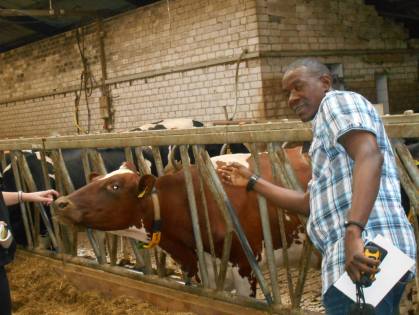

 Jägers Welten